Sunday, May 19, 2013

38 - En Route to Miami with the Farrells 1955


THE FONTAINEBLEAU, Miami Beach


The Fontainebleau Hotel, the early years (Library of Congress)

The same year of my first trip to New York with Aunt Frances, I traveled to Florida with the Farrell family.

Graham was my best friend in grammar school, and he often accompanied us to the Carthage Hotel for Sunday lunch (see Musing N° 2 of Sept. 7, 2012).   In fact, it was he who first mutilated those plastic table coverings.  Alternatively, I was regularly invited after church for fried chicken with the Farrells on Poplar Street.

In February or March of 1955 the Farrells --Cecil, Catherine and Graham-- planned their annual drive to Miami, and after a great deal of cajoling of both families by Graham and me, I was finally included in the trip.

It seems odd that I would have been able to miss so much school, but times were different, and I do remember my mother speaking with Mrs. Funderburk, my seventh grade teacher, who enthusiastically encouraged her to let me go.

I think we took three days to drive down.  I had been looking forward to staying at motels, but Graham’s parents would inevitably have an argument about the price, and we’d end up staying in a private home with rooms for rent. 

St Augustine, America's oldest city, vintage postcard
 I recall a particularly heated discussion, arriving in Saint Augustine, where there were scores of really snazzy motels as we entered the city.  Graham and I were jumping up and down in the back seat, shouting to stop at each one we saw, particularly those with swimming pools.  

Catherine was usually on our side, but we didn't stand a chance. Cecil definitely held the purse strings, and none of the prices suited.  In those days (perhaps it hasn’t changed), the room rate at U.S. motels was posted under the neon signs, and they were inevitably deemed too expensive.   Even at that age, I was surprised that no hotels had been reserved in advance.   

Me in Parrot Jungle, Miami (photo Graham Farrell)

Once in Miami, we spent much of the first day looking for a place to stay, scouting out rooming houses of which there were an abundance in the 1950’s.   We finally found one, and it seemed perfect to me, but I was still disappointed we hadn’t chosen a real hotel. 

  Graham's father was not a big traveller, but he had a special  affection for Miami, and driving through the countryside, Cecil talked to us at length about the Fontainebleau.   We were mesmerized, listening to his description of this super-modern hotel of inventive, circular architecture which he said was the finest and most expensive hotel in the world.  It had had its grand opening just a few months earlier.

One of the highlights of our trip was to be a visit to the Fontainebleau, but as I don’t actually remember anything about it, I suspect we only saw it from the outside.  I don't much imagine that back in those days it would have occurred to any of us to just march inside.

After a brilliantly successful first decade when it was embraced by show business stars and featured in numerous films and television specials, The Fontainebleau was not always able to maintain its prestige.  For a number of years, it fell, along with most of the rest of Miami Beach, on seriously hard times.  Rival Colombian and Cuban drug lords took over large suites to carry out their business, and several were arrested in the hotel in highly publicized crackdowns during the 1970's.

The Fontainebleau declared bankruptcy in 1977, but never completely shut down.  By 2006, most of the hotel's rooms were closed, and their furniture put up for auction.  Repeatedly rising from its ashes, however, the old Miami landmark reinvented itself under new ownership, and expanded, enlarged and completely redid itself in a flashy rebirth in 2008.

I have wonderful childhood memories of that week in 1955 with the Farrell family, but it is as though they end in Miami.  I have no recollection of the long drive back to Aberdeen.  Childhood was drawing to a close, and I don't think there were any more Sunday lunches at the Farrells after that trip.  In fact, I don't specifically recall going there again until the late 1960's when Cecil died, or much later when I once visited with Catherine during a trip home from Paris.  

When Brenda and I stopped over at the Winterhaven Hotel in 2011 on our way back to France from Panama, I looked forward to a visit to the Fontainebleau ... just to see what it had become.
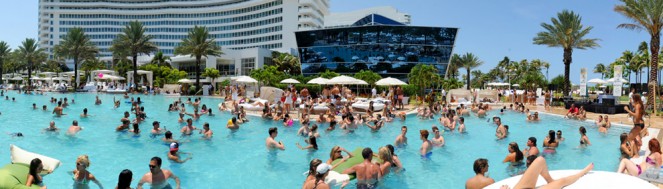
Crowded Fontainebleau pool today (photo Buenno)

What a disappointment!   Outside, it still had its unique architecture intact, but inside it looked much like a big city train station and just as impersonal.   With over 1500 rooms (!) and 12 restaurants, it embodied everything bad that you hear about Las Vegas …. or Miami hotels:  too big, too cold, too loud, too glitzy, too crowded!   On the plus side, we did eat a very nice hamburger there. 

Whatever it once may have been, at least in my eyes, The Fontainebleau is no longer.


SIDEBAR:  The Winterhaven


The Winterhaven Hotel 1945, as seen in vintage postcard

The Winterhaven is quite another story.  In fact, it would be accurate to describe it as pretty much the opposite of the Fontainebleau:  simple, attractive, and inexpensive. 

I discovered the Winterhaven in Miami Beach in 2003.  My father had been seriously ill and hospitalized for some weeks; he had recently returned home, and I was on my way to Aberdeen to see him.

I no longer remember by what fluke I found my route from Paris to North Carolina via Florida.   I had re-discovered Miami a few years earlier, and the Winterhaven had then been recommended as an inexpensive old hotel of a certain charm overlooking the ocean at the northern tip of South Beach.  

It is considered to be part of Miami Beach’s special art-deco architecture, though for purists, the Winterhaven like most of the others is a little late and more of a post-art deco, at least by European standards. 

Built in 1939, it has very pure lines.  It appears to have weathered the decades with grace, though I understand it was in a pretty dismal state by the 1980’s.    Like so many sea-front hotels there, most of the outside is white stucco, and it has enjoyed the revival of Miami Beach in the last decade or so.   Brenda and I recently  ran across an old picture book of art-deco architecture with a nice 1945 illustration of the Winterhaven (see photo).   

Unfortunately, I have a particularly sad association with The Winterhaven, as it was here just before leaving for Aberdeen in 2003, that I was informed of the death of my father.    Although I had enjoyed my stay, it left me --though of course through no fault of the hotel's-- with ambiguous memories.

I didn’t ever expect to have an occasion to return, but when Brenda and I decided to stay a couple of nights in Miami in 2011, it seemed an appealing choice to go back to.   It was almost as if I had a family connection there.  


The Winterhaven today (Photo Brenda P.)


AVA GARDNER STOPS IN ABERDEEN

Vintage Ava (MGM photo)

Few celebrities made their way to Aberdeen Eleanor Roosevelt passed through fleetingly the year  before I was born, and I once posed with my boy scout troop alongside Adlai Stevenson at Styers’ Filling Station during one of his unsuccessful presidential bids.


With Adlai Stevenson, me bottom right (photo Sandhill Citizen)

Townspeople did once get a peek of Ava Gardner, though I may be the only one left to tell the tale, admittedly second hand.  It was recounted to me and Graham during that road trip to Miami.  It was a tiny story of little consequence, but it fascinated us children, as Ava Gardner seemed like the biggest movie star in the world back in 1955.  [Cecil would undoubtedly be pleased to know that I have never forgotten it.]

Cecil Farrell had been a member of a local business owners' association during the Second World War.  Ava Gardner, as everyone may not know, grew up in a little hamlet a couple of hours away from Aberdeen, called Grabtown. 

With Rooney 1942 (MGM)

Cecil had been tipped off by a railroad official that Ava Gardner would be on the southbound train on a certain day, and that her train would actually be stopping, however briefly, in Aberdeen.

It had been her first visit back to North Carolina after marrying Mickey Rooney, and even though she had yet to make an important film appearance, the trip coincided with the considerable media attention she was receiving as an MGM starlet.

She, too, was on her way to Miami, before making the five-day train journey west back to Los Angeles.  


Cecil, along with other members of the Aberdeen business group, prepared to greet the North Carolina “girl-made-good” with a few words of welcome.  They were accompanied by several members of the high school band.

When the train pulled into Union Station, the delegation got a close look at the young Ava who was looking curiously out the window of her private drawing room.

Cecil said the band launched into a hearty rendition of “California Here I Come”, and he tried to motion for the actress to open her window before delivering his few words of welcome..

Ava Gardner looked at the unexpected welcoming committee,  made a little grimace, probably at the noise; and then, with not so much as a smile, she pulled down the shade. 

“And that was the last anyone in Aberdeen ever saw of Ava Gardner in the flesh,” Cecil concluded with a chuckle, and Catherine, who had heard the story many times, joined Graham and me in much laughter.


Aberdeen's Union Station at the turn of the century, unchanged today (Malcolm Blue Historical Society photo)


Your input is welcomed:  hotel-musings@hotmail.fr

Next Friday:  "Living It Up At The Dorchester"

  [Photos are mine, unless otherwise credited]


CROSS REFERENCING … a look at other postings
My first trip to New York with Aunt Frances was featured in blog No. 4, "A Two-Dollar Hamburger Under a Silvery Dome" Dec. 21, 2012, and blog No. 2 "Sunday Lunch with Grandmother Pleasants and Mrs. Kennedy" Sept. 7, 2012 (to access, click on title).




Friday, May 17, 2013

37 - The Decline of Madame Augier


THE NEGRESCO, Nice, France


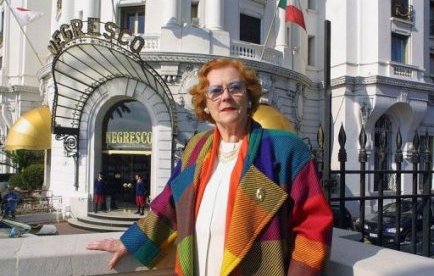
Negresco proprietor Jeanne Augier, three years ago (Le Point photo)

     Jeanne Augier turned 90 this year, and 2013 marks the 100th birthday of her prize possession, Nice’s Negresco Hotel.

Madame Augier’s presence these last 55 years has always given the Negresco a certain, extra panache.  Her red hair and horn-rimmed glasses have been as much a trademark of the Riviera palace as its distinctive pink dome and art-nouveau entryway.

I first saw her when I stayed there over Christmas of 1982.  She was rushing through the lobby, giving instructions to one of the hotel’s managers, and there was no mistaking who was in charge.

She has always had the last say in all decorating matters, and one of her eccentricities was to pepper the lobby with portraits … of Jeanne Augier!   In addition to paintings of herself, Madame Augier owns an interesting, oddly eclectic collection of art and art objects which is an integral part of the hotel’s decoration.
 

Nikki de Saint Phalle sculpture in main lobby

The spectacular Baccarat crystal chandelier (above photo) in the Royal Lounge was commissioned by Czar Nicholas II, who was unable to take delivery due to the Russian Revolution.   The emblematic verrière (glass roof) is set in a frame designed by Gustave Eiffel.


 Jeanne with Papa vacationing in Nice circa 1933 (Negresco)

Jeanne Augier was an only child, and her father, a self-made millionaire, adored her.  So much so that in 1957 he bought the Negresco for her and her late husband.  It was then not at the top of its form, but the Augiers transformed it into one of France’s most prestigious and best known hotels, consistently attracting heads of state, royal families and assorted film and theatre luminaries for the past six decades. 


In the hotel dining room 50 years ago (Negresco Collection)

When I began returning with Brenda to Nice in 2007, we frequently elected for the Negresco’s Sunday luncheon, an excellent and elegant meal for a bargain price proposed by the Chantecler’s star chef Jean-Denis Rieubland. 

Mme Augier was invariably there at her special little table, usually alone.  She would arrive with her own napkin, and on a number of occasions we observed her putting bits and pieces of lunch into her pocket book.

At a restaurant as elegant as the Chantecler you wouldn’t generally think of asking for a doggy bag, and for the owner it did seem odd to be spiralling away food.  Particularly since she lives in a vast apartment on the top floor of the hotel, and could surely have the kitchen whip up anything she wished at any hour.

 For many years she had a tall, Senegalese butler who seemed to be making it possible for her to slip into old age unobtrusively.  He was omnipresent; everyone knew his face and silhouette in Nice.

Annie and Punjab
Despite the Negresco owner’s advancing years, the sight of her with the imposing butler brought to mind Little Orphan Annie and her faithful Punjab!

Staff worried what would happen to this seemingly devoted domestic if Mme Augier were to go meet her maker, whether he would be generously remembered or not.

They needn’t have bothered, because it was the butler who unexpectedly dropped dead of a heart attack several years ago.  Mme Augier, already well over 80, must have been destabilized by the loss.  But she soon picked herself up and replaced him with the butler’s young neice.

Brenda in the Salon Versailles, 2010

In the last year or so, I haven’t seen much of Mme A.  Her restaurant table is usually empty. 

Then just a few weeks ago,  on the eve of her 90th birthday, the news hit Nice like a bombshell.  Madame Augier, “suffering from little memory losses” and confined to a wheelchair, had been placed under a judicial guardianship.  At the same time the local courts have appointed a separate guardian to oversee the running of the hotel.

Rumors were rife.  Newspapers speculated on stolen jewels, missing stocks and various shenanigans involving unscrupulous personnel taking advantage of the elderly Negresco owner.  Police were notified by her priest who was reportedly witness to certain “abuses.”

“It’s like swimming in the middle of an Agatha Christie mystery,” the hotel’s managing director recently told the newspaper Nice Matin.

Jeanne Augier has always been a very independent lady with a --shall we say-- strong personality.   One anonymous hotel employee went so far as to tell the Agence France Press that his employer was often “stubborn as a mule …. and not always appreciated by all.”

Business goes on these days almost as usual at the Negresco.  Police have announced the investigation “will take the time it takes.”  The judicial administrator has begun the massive task of studying the hotel’s and Mme Augier’s accounts for the last two years, as well as overseeing the day-to-day running of the hotel.  The Negresco lost over 1.3 million dollars last year.  


Wheelchair bound, Mme Augier remains an imposing figure (Pure-people photo)

For the moment, no one knows what the future holds for the Nice landmark or for its 176 employees.  The only thing for sure is that things will never be quite like before, neither for Jeanne Augier nor for her hotel.


Negresco by night 2012


input is welcomed:  hotel-musings@hotmail.fr
Next Friday:  "Driving to Miami with the Farrells"

[Photos are mine, unless otherwise credited]


CROSS REFERENCING … a look at other postings
The Negresco was also featured in blog No. 17, "Celebrating the Holidays Away From Home" Dec. 21, 2012 (to access, click on highlighted title).


Friday, May 10, 2013

36 - The Good and the Bad…a New Kind of Hotel


AKA SUTTON PLACE,  New York City


AKA's intimate lobby, Michael clowning in the distance

Our first contact with AKA was catastrophic.  Already irritable and exhausted after a difficult flight from Paris, we discovered on arrival at the Sutton Place “hotel alternative” that our reservations had been cancelled.

On the good side, the staff was --from the very first moment-- impeccably friendly and whatever the problem (and there have indeed been a few), systematically in search of the best solution.  When we located our own copy of the booking confirmation, things began to quickly work themselves out.

The young man responsible for accidentally destroying our reservations was clearly humiliated and devastated by the public outing of his inefficiency.   I felt sorry for him, and it was soon apparent the incident was apt to bring us future good will, which I always welcome.   

By mid-week, we were thoroughly won over, thrilled with the overall luxury of the surroundings, and of the terrific interaction with the staff.  The entire concierge desk seem to absolutely love its work.  To a man (or woman), they take enormous pleasure in chatting with guests, and generally rendering themselves helpful whenever possible.

One evening  we did have a key problem.   We had been given the wrong key, and it took quite a lot of effort on everyone’s part before figuring out why the key no longer fit our apartment.   It was no big deal, but still kind of a bad omen.

Then, the following day, after some pretty heavy walking, including a fairly long hike across the Brooklyn Bridge, Brenda returned to our apartment alone.  I had some errands to do in the neighborhood. 


Manhattan seen from the Brooklyn Bridge


 Back at the hotel, one of the staff warned me there had been a “bit of a problem,” but assured me all been taken care of.   He didn’t wish to elaborate, and I was more than intrigued.  

Brenda met me at the door. She was laughing and almost crying at the same time.  The adventure she recounted was not banal:   Back in our apartment a few minutes earlier, she had started undressing to take a shower, and as she sat on the bed to remove her shoes, just like in the tale of Goldilocks and the three bears, she suddenly realized someone was asleep on our bed.   

Mrs. Singh
 It turned out to be a charming Indian lady, who had travelled just that day from New Delhi to attend the graduation of her nephew at New York University.  Brenda and Mrs. Singh were mutually flabbergasted.   They both had a momentary fright, a bit of an embarrassing moment, and ultimately a laugh, too.

The extended family of Mrs. Singh occupied the two next door apartments, and the downstairs clerk had inadvertently given the jet-lagged Mrs. Singh the wrong key --ours.   Of course there was no real harm done, but it certainly didn’t look very serious on the part of the hotel.

Nevertheless, there was a silver lining:   the management, thoroughly contrite, insisted on refunding a night’s lodging, which was more or less the maximum one might expect under such circumstances and a welcome economy to our New York budget. The rest of our stay went off without a hitch. 

There is a superb postscript to this story, as the best was yet to come.  Returning in 2010, I figured with all of our mishaps of the previous year, we might hope to get a special welcome.  That was not immediately in the cards.  We were ushered into a tiny, very dark apartment, clearly in need of repairs, and told with a straight face it was one of their most popular.

 When I objected, my interlocutor --as always-- showed plenty of good will in finding a solution.  Michael was a young, very personable New Yorker.  He took me aside and whispered that he remembered last year’s regrettable incident with Mrs. Singh, that if I could just wait 24 hours longer, the penthouse suite would become available, and we would be welcome to move in.  Needless to say, at no additional cost.

We waited the 24 hours, and our expectations were all surpassed.  It was at least 1000 square feet surrounded by panoramic windowing with stunning views of the city skyscape.   Cary Grant would have felt right at home. 

Brenda puttering about in the early morning


So there you are.  AKA has never been quite perfect, but it’s all a bit of give and take, and in our experience the give and the take have balanced themselves out rather nicely.

Room with a real New York view !


 SIDEBAR:  Sutton Place

Queensboro Bridge seen from Sutton Place Park 2010


Hollywood has long perpetuated the image of New York City’s Sutton Place as the very epitome of chic.


Onassis (Google photo)
Crawford (Warners)
 Film notables, including Joan Crawford and Marilyn Monroe, made their real life homes on Sutton Place.  Other residents have included Aristotle Onassis, Michael Jackson and Sigourney Weaver, to name but a few. 


Several scenes from both Woody Allen’s “Manhattan” and “Annie Hall” were filmed there, as well as exteriors in the original “Manchurian Candidate” and the remake of “Scarface.”

 Hollywood most memorably captured the neighborhood in “How to Marry a Millionaire,” the story of three almost penniless glamor girls who pool their resources to rent a luxury apartment for one month with the goal of nabbing rich husbands. 

Billed as the first comedy in Cinemascope, I wanted to see it as part of my 11th birthday party, but my mother insisted that the children vote;  I had to go to “King Solomon’s Mines” instead.


Vintage movie poster (20th Century Fox)


Your input is welcomed:  frank.pleasants@libertysurf.fr

Next Friday:  "The Decline of Mme Augier ... goings-on at the Negresco"

  [Photos are mine, unless otherwise credited]


Friday, May 3, 2013

35 - Hollywood on the Hudson


THE WYNDHAM, New York City


The old  Wyndham on West  58th Street, fronting the back of the Plaza, was in some ways my favorite New York hotel.  Though certainly never one of the most luxurious, and by the time I arrived it had decidedly known better days, it remained wonderful value for money.

For the price of an inexpensive room elsewhere, the Wyndham had some knockout suites.  Opened in 1929, the hotel’s golden era was the 1950’s.  New York was then the television capital of the world, and the Wyndham welcomed some of the new medium’s most sophisticated ladies and gentlemen, often for prolonged stays

Until its demise in 2005, it continued to maintain a crew of elevator operators for its antiquated lifts.

Meadows (Scott Allen photo)
 Danny was a little bit slow, very friendly and much beloved by many returning clients.   I once observed the actress Jayne Meadows in an animated conversation with him.  She was wearing the biggest dark glasses imaginable, the kind Cadillac might produce if they were in the sunglasses business.


“But Danny, concentrate, you’ve got to concentrate.  I left my suitcase with you last month.  Now you must find it.  Do try to concentrate, Danny.”  She enunciated each word as though projecting to the last balcony.  I hope he did remember.

Rarely has such a simple and little known hotel played host to quite such an impressive array of film and theatre luminaries.  

Laurence Olivier first stayed at the Wyndham in 1976 during the filming of "Marathon Man", a spy drama directed by John Schlesinger and co-starring Dustin Hoffman.  Dick Cavett interviewed him there from suite 1401.  

Hackman and smiling wife (Google)
 I ran into Gene Hackman several times, usually in the elevator.  He always spoke and smiled as though we were old friends.  He was invariably with an asian woman I assumed to be his wife.  She neither spoke nor smiled.  John Cassavetes introduced Peter Falk and Ben Gazzara to the hotel.  
Tandy and Cronyn (Google)


 Jessica Tandy and husband Hume Cronyn had their New York  apartment in the Wyndham.  On the week of Miss Tandy's death the lobby was filled with flowers, mostly roses, of condolence.  


 Grace Kelly lived in the Barbizon for Women when she first moved to New York in the late forties to seek a career on the stage; but she too had regular contacts with the Wyndham, as her favorite uncle, playwright George Kelly, often stayed there.  In later years, Princess Grace owned a smallish pied-à-terre around the corner on Park Avenue, and she sometimes put guests up at the Wyndham.   
    

Early Grace (photo by Life)

  Ingrid Bergman stayed several weeks in 1982.  Dying of cancer, she came to New York to celebrate the 30th birthday of her twin daughters, Isabella and Ingrid Rosellini.

Arlene Dahl (left), Ben Gazzara and Wyndham owner Suzanne Mados (N.Y. Social Diary)

It was a family owned enterprise, and the proprietors, John and Suzanne Mados, had some solid connections in the show business world.  He sometimes gave cocktail parties across the street at the Sherry Netherlands, with various film luminaries from the fifties, faithfully reported by Liz Smith in her column.  Piper Laurie and Jane Powell always seemed to be in attendance, as were often Arlene Dahl and Gena Rowlands.

The Redgrave-Neros (AP)
 I once saw Vanessa Redgrave arrive with her ex and future companion, Franco Nero, to visit their daughter who was staying there.  The lobby was European shabby-chic, the guests were somewhat the same, and no one other than myself seemed to give the Redgrave-Neros so much as a passing glance.

Around 2000, I had a client who ran a shop in Bergdorf Goodman’s next door.  She was a bit eccentric (not to say that I am not) and perhaps a little snobby (some say I am, but I am not).  I was afraid she’d be put off by the kitsch decor, but I nevertheless invited her by for a meeting.  She was absolutely enamored of the place, and I was bursting with pride as she covered me with compliments for uncovering such a funny little gem.

Jane in  suite 804, summer of 2000


It was never perfect, you had to accept its terms:  no dial telephones,  no turndown service, and no fancy designer toiletries either. The Laurence Oliviers and Lena Horne had to make do like the rest of us with those little mini bars of Ivory soap.

At the very end there was talk of mice, but I never saw any.  At best it was an oasis of civility in a very quirky environment; at worst, settling into the 21st century, it was beginning to resemble a once perky old lady in the early throes of Alzheimers.   

Still, I’d love to be able to stay there again, just once more.

Suite 824, September 1990 (Photo Pascale Charmet)


 SIDEBAR:  What Next?

Vintage postcard of 5th Avenue at 58th Street

When the Wyndham finally closed shop in 2005, it remained vacant for some time.  This coincided with the lengthy closing and renovation of the Plaza across the street, so that part of 58th Street looked pretty lonely for awhile.

Around 2008 I noticed new life at Number 42.  At first it appeared to be just another apartment building, then I learned the site was sort of a hotel, though a very discreet one and with an emphasis on longer rentals than one or two nights.

Called the AKA, it was a new chain with five or six of its clubby branches scattered around the city.  Most of the accommodations were one bedroom apartments.

Otherwise, the AKA is run just like a luxury hotel with a particularly well trained and polished concierge staff.

I was intrigued.  Prices were flexible, according to season and availability, and for our next trip to New York we decided to give the AKA a try.   Despite my affection for the Central Park South location of the old Wyndham, we ultimately opted for the Sutton Place branch.  It was the only one with a pool, and the neighborhood was a new one to explore. 

I was about to discover another kind of lodging –half grand hotel, half apartment building.  When it works like it’s supposed to, you have the best of both worlds.

Stay tuned.

Sutton Place, Queensboro Bridge (Google photo)


 Your input is welcomed:  hotel-musings@hotmail.fr

Next Friday:  "The Good and the Bad ... Sutton Place AKA"

  [Photos are mine, unless otherwise credited]