Friday, July 10, 2015

En Route To Miami With The Farrells

THE FONTAINEBLEAU, Miami Beach
(this posting originally appeared in May 2013)

The Fontainebleau Hotel, the early years (Library of Congress)

The same year of my first trip to New York with Aunt Frances, I traveled to Florida with the Farrell family.

Graham was my best friend in grammar school, and he often accompanied us to the Carthage Hotel for Sunday lunch (see Musing N° 2 of Sept. 7, 2012).   In fact, it was he who first mutilated those plastic table coverings.  Alternatively, I was regularly invited after church for fried chicken with the Farrells on Poplar Street.

In February or March of 1955 the Farrells --Cecil, Catherine and Graham-- planned their annual drive to Miami, and after a great deal of cajoling of both families by Graham and me, I was finally included in the trip.

It seems odd that I would have been able to miss so much school, but times were different, and I do remember my mother speaking with Mrs. Funderburk, my seventh grade teacher, who enthusiastically encouraged her to let me go.

I think we took three days to drive down.  I had been looking forward to staying at motels, but Graham’s parents would inevitably have an argument about the price, and we’d end up staying in a private home with rooms for rent. 

St Augustine, America's oldest city, vintage postcard
 I recall a particularly heated discussion, arriving in Saint Augustine, where there were scores of really snazzy motels as we entered the city.  Graham and I were jumping up and down in the back seat, shouting to stop at each one we saw, particularly those with swimming pools.  

Catherine was usually on our side, but we didn't stand a chance. Cecil definitely held the purse strings, and none of the prices suited.  In those days (perhaps it hasn’t changed), the room rate at U.S. motels was posted under the neon signs, and they were inevitably deemed too expensive.   Even at that age, I was surprised that no hotels had been reserved in advance.   

Me in Parrot Jungle, Miami (photo Graham Farrell)

Once in Miami, we spent much of the first day looking for a place to stay, scouting out rooming houses of which there were an abundance in the 1950’s.   We finally found one, and it seemed perfect to me, but I was still disappointed we hadn’t chosen a real hotel. 

  Graham's father was not a big traveller, but he had a special  affection for Miami, and driving through the countryside, Cecil talked to us at length about the Fontainebleau.   We were mesmerized, listening to his description of this super-modern hotel of inventive, circular architecture which he said was the finest and most expensive hotel in the world.  It had had its grand opening just a few months earlier.

One of the highlights of our trip was to be a visit to the Fontainebleau, but as I don’t actually remember anything about it, I suspect we only saw it from the outside.  I don't much imagine that back in those days it would have occurred to any of us to just march inside.

After a brilliantly successful first decade when it was embraced by show business stars and featured in numerous films and television specials, The Fontainebleau was not always able to maintain its prestige.  For a number of years, it fell, along with most of the rest of Miami Beach, on seriously hard times.  Rival Colombian and Cuban drug lords took over large suites to carry out their business, and several were arrested in the hotel in highly publicized crackdowns during the 1970's.

The Fontainebleau declared bankruptcy in 1977, but never completely shut down.  By 2006, most of the hotel's rooms were closed, and their furniture put up for auction.  Repeatedly rising from its ashes, however, the old Miami landmark reinvented itself under new ownership, and expanded, enlarged and completely redid itself in a flashy rebirth in 2008.

I have wonderful childhood memories of that week in 1955 with the Farrell family, but it is as though they end in Miami.  I have no recollection of the long drive back to Aberdeen.  Childhood was drawing to a close, and I don't think there were any more Sunday lunches at the Farrells after that trip.  In fact, I don't specifically recall going there again until the late 1960's when Cecil died, or much later when I once visited with Catherine during a trip home from Paris.  

When Brenda and I stopped over at the Winterhaven Hotel in 2011 on our way back to France from Panama, I looked forward to a visit to the Fontainebleau ... just to see what it had become.
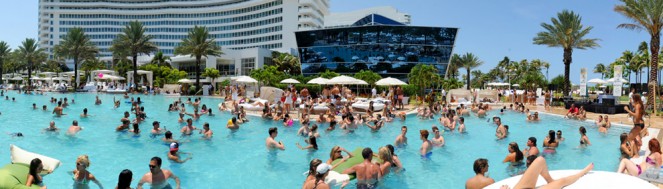
Crowded Fontainebleau pool today (photo Buenno)

What a disappointment!   Outside, it still had its unique architecture intact, but inside it looked much like a big city train station and just as impersonal.   With over 1500 rooms (!) and 12 restaurants, it embodied everything bad that you hear about Las Vegas …. or Miami hotels:  too big, too cold, too loud, too glitzy, too crowded!   On the plus side, we did eat a very nice hamburger there. 

Whatever it once may have been, at least in my eyes, The Fontainebleau is no longer.


SIDEBAR:  The Winterhaven


The Winterhaven Hotel 1945, as seen in vintage postcard

The Winterhaven is quite another story.  In fact, it would be accurate to describe it as pretty much the opposite of the Fontainebleau:  simple, attractive, and inexpensive. 

I discovered the Winterhaven in Miami Beach in 2003.  My father had been seriously ill and hospitalized for some weeks; he had recently returned home, and I was on my way to Aberdeen to see him.

I no longer remember by what fluke I found my route from Paris to North Carolina via Florida.   I had re-discovered Miami a few years earlier, and the Winterhaven had then been recommended as an inexpensive old hotel of a certain charm overlooking the ocean at the northern tip of South Beach.  

It is considered to be part of Miami Beach’s special art-deco architecture, though for purists, the Winterhaven like most of the others is a little late and more of a post-art deco, at least by European standards. 

Built in 1939, it has very pure lines.  It appears to have weathered the decades with grace, though I understand it was in a pretty dismal state by the 1980’s.    Like so many sea-front hotels there, most of the outside is white stucco, and it has enjoyed the revival of Miami Beach in the last decade or so.   Brenda and I recently  ran across an old picture book of art-deco architecture with a nice 1945 illustration of the Winterhaven (see photo).   

Unfortunately, I have a particularly sad association with The Winterhaven, as it was here just before leaving for Aberdeen in 2003, that I was informed of the death of my father.    Although I had enjoyed my stay, it left me --though of course through no fault of the hotel's-- with ambiguous memories.

I didn’t ever expect to have an occasion to return, but when Brenda and I decided to stay a couple of nights in Miami in 2011, it seemed an appealing choice to go back to.   It was almost as if I had a family connection there.  


The Winterhaven today (Photo Brenda P.)


AVA GARDNER STOPS IN ABERDEEN

Vintage Ava (MGM photo)

Few celebrities made their way to Aberdeen Eleanor Roosevelt passed through fleetingly the year  before I was born, and I once posed with my boy scout troop alongside Adlai Stevenson at Styers’ Filling Station during one of his unsuccessful presidential bids.


With Adlai Stevenson, me bottom right (photo Sandhill Citizen)

Townspeople did once get a peek of Ava Gardner, though I may be the only one left to tell the tale, admittedly second hand.  It was recounted to me and Graham during that road trip to Miami.  It was a tiny story of little consequence, but it fascinated us children, as Ava Gardner seemed like the biggest movie star in the world back in 1955.  [Cecil would undoubtedly be pleased to know that I have never forgotten it.]

Cecil Farrell had been a member of a local business owners' association during the Second World War.  Ava Gardner, as everyone may not know, grew up in a little hamlet a couple of hours away from Aberdeen, called Grabtown. 

With Rooney 1942 (MGM)

Cecil had been tipped off by a railroad official that Ava Gardner would be on the southbound train on a certain day, and that her train would actually be stopping, however briefly, in Aberdeen.

It had been her first visit back to North Carolina after marrying Mickey Rooney, and even though she had yet to make an important film appearance, the trip coincided with the considerable media attention she was receiving as an MGM starlet.

She, too, was on her way to Miami, before making the five-day train journey west back to Los Angeles.  


Cecil, along with other members of the Aberdeen business group, prepared to greet the North Carolina “girl-made-good” with a few words of welcome.  They were accompanied by several members of the high school band.

When the train pulled into Union Station, the delegation got a close look at the young Ava who was looking curiously out the window of her private drawing room.

Cecil said the band launched into a hearty rendition of “California Here I Come”, and he tried to motion for the actress to open her window before delivering his few words of welcome..

Ava Gardner looked at the unexpected welcoming committee,  made a little grimace, probably at the noise; and then, with not so much as a smile, she pulled down the shade. 

“And that was the last anyone in Aberdeen ever saw of Ava Gardner in the flesh,” Cecil concluded with a chuckle, and Catherine, who had heard the story many times, joined Graham and me in much laughter.


Aberdeen's Union Station at the turn of the century, unchanged today (Malcolm Blue Historical Society photo)


Your input is welcomed:  hotel-musings@hotmail.fr


  [Photos are mine, unless otherwise credited]


CROSS REFERENCING … a look at other postings
My first trip to New York with Aunt Frances was featured in blog No. 4, "A Two-Dollar Hamburger Under a Silvery Dome" Dec. 21, 2012, and blog No. 2 "Sunday Lunch with Grandmother Pleasants and Mrs. Kennedy" Sept. 7, 2012 (to access, click on title).


Sunday, May 31, 2015

The Beginning and the End of Duncan

GRAND ALBERGO TIMEO  --Taormina, Sicily
(originally appeared in November 2012)

Duncan at the Timeo 1980

             Duncan was conceived at the Timeo Hotel.  At least that is the story he told. 

Americans of  means, his parents came to Europe on their honeymoon a year or so before the outbreak of the First World War.  They spent a season  in Taormina and established a lifelong affection with the Timeo.

The Timeo garden terrace today
 Duncan in 1980 had more than continued the tradition.  A hypochondriac and a perpetual depressive, he had pretty much given up on life and had been living in a room at the Timeo for several years when I met him.

An indiscreet hotel manager confided that Duncan was “not too keen for the ladies” and that his friend had left him several years previous, which had precipitated the permanent move into the Timeo.

He had once been a professional photographer, and had first come to Taormina in the late forties to photograph the majestic mountain and seascapes.

von Gloeden (google)
Taormina historically had an attraction for the gay community.  Before the turn of the 20th century, the renowned German photographer Wilhem von Gloeden established a somewhat sulphurous reputation in Taormina, photographing local shepherd boys in the nude, often imitating the poses of Greek and Roman statues. 
Early Capote (google)

Oscar Wilde was one of the first British dandies to visit the hilltop town.     Shortly after the end of the Second World War, Truman Capote led a contingent of jet-setting artists there.  He spent over a year, which he wrote about in his essay “Fontana Vecchia.”   

Duncan first arrived at the Timeo at about this time.

All of the Anglo Saxons and most of the Italians staying at the hotel knew him.  He enjoyed telling guests how unhappy he was and how ineffectual was the lithium he took every morning.  Despite his seemingly permanent state of depression, he never left his room without jacket and tie.

  Taormina was no longer exclusively reserved for the happy few.  “Look at those dreadful tour groups”, he said one day, taking his daily stroll down the Corso.  “They all give me the creeps.”  The world was changing, and neither Duncan nor the Timeo wished to follow suit.

“When I wake up, I think ‘Oh, God, no, not another day, I cannot stand another day on this earth !”

Table with a View --Lunch at the Timeo 2015

The hotel’s concierge sent me a postcard a few months after my last trip there, reporting that the “grim reaper” had finally paid Duncan a visit. 


A Few Randon Timeo Faces

Anne

 Of all the many photos I seem to remember taking during my stays at the Timeo, only a few remain.  

Claudia
Urzio
Mario

A few years ago, I had the bright idea of getting rid of several boxes of old memorabilia, including clippings and notebooks ... and many photos.   At that time I hadn't looked at them in at least two decades, and I couldn't find a convincing reason to keep them. 

 I was a little obsessed with the memory of my mother on her deathbed, sifting through boxes of family photos, sorting things for different family members and friends to be dispatched after her death.  I couldn’t understand why she never seemed to finish, until I realized that those boxes of memorabilia were somehow the only thing keeping her alive. 

  Although there was nothing exactly negative about this, I did not wish to imagine myself in similar circumstances.  I had enough of an attachment for the memories that those miscellaneous papers documented that I somehow didn't like the idea of them being thrown away by someone else when I would no longer be around or in charge. 

So I chucked out a good part of my old souvenirs and held back a handful of photos for no specific reason.   They are pretty much all that remain of my Timeo-people memories.   Just a few little bits and pieces:  

Maria

 Maria was an English spinster, whose traveling companion (whom we never actually saw) was confined to her room with a sudden, serious illness.  She joined us for Christmas dinner, and I am thoroughly ashamed to say we were most unhappy when she continued to join us in the days that followed.

Pier Luigi
Pier Luigi and Suzanne


     Pier Luigi met his French friend Suzanne at the Timeo every year for a holiday vacation.  He was, according to Suzanne, recovering from a serious  nervous breakdown, though he always seemed in total control.


The Augers were an Anglo-American couple, regular returning guests at the Timeo.  Hugh, a rather bombastic retired army major,  was to our eyes --to Anne's and mine-- foolishly pompous.  Betty, despite a softer, warmer facade, bore a sometimes uncanny resemblance in her manner of being and flat American accent to Wallis Simpson, Duchess of Windsor. 
    
The Augers

There was undoubtedly a story somewhere behind each of these faces.  However, the above jottings represent  the extent of my memories.  So the Timeo vignettes end today with Duncan.


Your input is welcomed:  frank.pleasants@libertysurf.fr


 [Photos are mine unless otherwise credited]

Wednesday, April 29, 2015

Clementina, Still Lady of the Manor ...

GRAND ALBERGO TIMEO  --Taormina, Sicily

(This musing was originally posted in October 2012)

Clementina 1978


       When I met Clementina La Floresta, she  had already been at the Timeo for nearly seventy years.  She was closing in on ninety and her mind had begun to waver, but she was often alert and retained a sharp memory for the distant past. 

She was the Timeo’s owner, at least she had been.  Her adoring daughter and son-in-law had long since taken over the day-to-day management, but Clementina was usually there, seated regally in the lounge, ready to chat with guests, effortlessly diving in and out of a number of languages.

She had arrived in Sicily shortly after her eighteenth birthday to marry the owner of the esteemed Timeo, already a Taormina landmark after several decades of activity.

Portrait of Marcel Proust 1892
“I remember as if it were yesterday,” she once told me.  “My very first week in the hotel, I had the formidable task of having to escort Monsieur Marcel Proust into the dining room for dinner.  I was shaking like a leaf.”

She soon accustomed  herself to being the Timeo’s official hostess, and found herself charming the likes of Andre Gide and D.H. Lawrence (who is said to have written much of Lady Chatterly's Lover there); later Sophia Loren and Marcello Mastroianni.  Not to mention the Vanderbilts, the Rothschilds and the Krupps.

At a time when world travel was reserved for the privileged, the Timeo was for connoisseurs.

In the ensuing years when I would return at Christmas, she was less chatty, but she always greeted each guest graciously with a smile, still very much the lady of the manor.

On my last visit in the early eighties, her daughter told me, with tears in her eyes,  the hotel was being sold.   It was a family tragedy, she said.  She and her sisters were born there; it had been created in 1873 by their grandfather..

Interior of the Timeo today (photo Orient Express)

There had been tensions between the siblings, and two other sisters, long since expatriated to Rome and Milan,  had preferred their part in cash.  The property was now worth much more than the hotel, itself.  It had its loyal following, but theirs had been an old- fashioned management, often wary of the modern world.    They hadn’t even wanted a pool, fearing it would attract a less desirable clientele.   

The sale had one important stipulation: Clementina and her family were to remain on the premises, and the old lady was never to be told the Timeo had been sold. 

In less than a year the hotel had closed down.  The buyer ended up in prison, though I never knew why.  It remained shut for many years thereafter, before being purchased by the Orient Express company.

I like to think that Clementina died in her own bed.    


Your input is welcomed:  frank.pleasants@libertysurf.fr

[Photos are mine, unless otherwise credited]


  CROSS REFERENCING … a look at other Timeo postings
The Timeo was first featured in "Room Without Bath" in Sept. 2012; and "The Beginning and the End of Duncan" Nov. 2012 (to access, click on titles).


Friday, April 24, 2015

Living It Up On A Budget

HOTEL BRISTOL, Paris


Sunday afternoon at the Bristol
(Originally posted February 2013/the improved dollar has kept the price about the same)

Times are kind of hard, and some days we just have to face facts.    As I tell the grandchildren (which for some reason sends them into great gales of laughter):  “Money does not grow on trees!”

There haven’t been enough earnings lately finding their way into the coffers to justify much of a splurge.  Consequently, I figure I can count my blessings, savor  past memories (that’s what I’ve been doing these last months on “Hotel Musings”), and enjoy some of the cheaper deals out there.

Tea time

As high living goes, coffee at the Bristol must be the best value for money that Paris has to offer these days.  It is (relatively) cheap AND about as luxurious an afternoon’s outing as you could imagine.
  
Here’s the deal:  For just a tad over a ten-dollar bill (nine euros, to be exact), I invite you to enter the exquisite world of the rich and sometimes famous.


Fiona "at home" in lobby
Lorna on recent coffee tasting  expedition
The Bristol is arguably Paris' chic-est hotel address.  It reeks of understated elegance at its best, and is the home away from home of Robert de Niro, Angelina and Brad, Paul McCartney, to name but a few.  


A number of scenes from Woody Allen's popular "Midnight in Paris" were filmed here.

Originally a private mansion, it was already almost 200 years old when transformed into a luxury hotel in 1925.  It was named after the 4th Earl of Bristol, an Englishman  noted for his travels around Europe in the 18th century.


Brenda, a little touch-up
Former president Nicolas Sarkozy (as well as quite a few presidents before him) made the hotel's Epicure restaurant his canteen, stopping by regularly from his presidential offices across the street.

Nowadays, socialist president François Hollande would sooner be caught dead than publicly associated with such luxury, so there is little chance of running into him or any of his cabinet members.  It is said that key government members have been discouraged from patronizing the Bristol, and certainly are NEVER to be photographed there.

Coffee is served in the grand foyer-tea room-bar area, which is an extension of the main lobby.  If you wish to stay on budget, then it is mandatory to rigorously follow my instructions. 
 

The high-life version of a cup of coffee


Do not bother with the menu.  There is an abundance of tempting snacks, all sorts of mouth-watering desserts and an assortment of teas from the far corners of the globe.    Ignore all of the preceding. 

When the waiter arrives, just say:  “un cafĂ©, s’il vous plait.”  [euuh  KAH-faye, SEEL voo play].  Naturally, you can say it in English, if you wish; but in that case, it is best to specify “an espresso coffee.”

In addition to a pretty heady environment of grand hotel aesthetics and celebrity comings and goings, here’s what you get:  one perfect Parisian espresso; one pretty little bottle of designer water; dainty old-fashioned, embroidered linen cocktail napkins; and --last but so not least--  an assortment of three, four or even six (depending on the mood of the day) delicious homemade chocolate candies.  All this to the accompaniment of discreet rippling chords from the resident harpist.

A tip is definitely not mandatory, as it is ostensibly always included in France.  However, you are not forbidden to leave the remaining one euro on the little silver dish.

Not bad as hotel lobbies go!


Sunday, April 5, 2015

Mrs. X at the Gritti

The Gritti Palace, Venice


Room with a view  (From the balcony of N° 215)


Some hobbies, like my hotel passion, can get kind of lonely.  Unlike stamp collectors and film buffs and dog breeders, it’s unusual to meet anyone else with a very similar hobby.  Not only would most people never dream of going to some of “my” hotels, they would often find my extravagances peculiar if not objectionable.

So you can imagine that I was excited to receive a rather special email a number of years ago.  It was from Miranda, a lady from Beverly Hills, a part-time travel agent, no less, asking my hotel advice.   

I had posted a complimentary review on the Fodor’s travel site of my favorite Venetian hotel, the Gritti Palace.  


Breakfast for two on the Gritti's Grand Canal Terrace
Miranda was looking into the better Venice hotels in view of an upcoming trip, but had found the Gritti prices far steeper than any of the others.  “We read your posting, and found your critique most persuasive," she said. “Is it really worth the difference?  We cannot make up our minds, but would be extremely interested in anything you might have to say.  You seem so knowledgeable and enthusiastic."  
 
I don’t think anyone --certainly no one outside my circle of acquaintances-- had ever sought out to such an extent my hotel expertise. 

So I was thrilled with the potential assignment from the other side of the world from this woman whom I would undoubtedly never have the occasion to meet in person.  Ultimately I was able to help considerably.  

Miranda explained that my arguments had convinced her, if only they could somehow find a more appealing price.  After several emails --by which time I was thinking of her as pretty much an old friend-- I proposed telephoning, myself, to the Gritti’s then-reservations manager, Signor Mora, who had always been helpful in securing the best prices. 

 To make a long story shorter, Miranda gave every appearance of being just about blown away when I ultimately was able to report that Signor Mora had agreed to a price close to half of that originally mentioned.  He  had also noted “VIP treatment” on the internal reservations record, assuring an unexpected bonus, and he further promised  they would give the best accommodations possible to Mrs. X. 

“Thank you, thank you, thank you,” she wrote  “to think that we as travel agents couldn’t do better, and all you have done is just too marvelous.  I only hope to one day be able to return the favor for you.”  Her enthusiasm was already a sufficient reward, and I reveled in her satisfaction and vicariously savored her upcoming week at the Gritti.     

I explained that it would be in both our interests for her to ask to see Signor Mora and to express a special  thank-you to him upon arrival.  I also recommended she tell Gianni, the  head concierge, that I had urged her to avail herself of his talented services.

I was looking forward to a full report on the Venice trip, and she even promised to send photos of  her room upon  return to California.  I waited several weeks, then I couldn’t restrain myself from sending another email, asking how everything had gone, and to please send all the details!

Ultimately I felt quite foolish, because  I never, ever heard from her again.

Some months later, I had occasion to talk again with Signor Mora at the Gritti.  I was enquiring about room rates, both for me and for friends from North Carolina.  Suddenly, out of the blue, Signor Mora asked, “Will Mrs. X  be coming this time?”  His tone alarmed me. 

Gritti facade seen from the canal
 Mora was a warm and gentle person, but this time he persevered with a certain tense fervor.  “Because I believe Mrs. X was not entirely happy with us, I don’t expect that she would wish to return to the Gritti.   No, I’m quite sure that would not be a very good idea.”

I was appalled that everything had somehow gone so badly.  Mora had always bent over backwards to help, and I had been so pleased that he would be looking after my new internet friend.   I made a stab at finding out what exactly had transpired, but clearly Mora had said all he intended to.

 I would never know what had happened.  I do feel certain of one thing: that whatever problems or dramas may have occurred were of neither Signor Mora nor the Gritti’s doings.

Evening snack in room 313
-o-

Your input is welcomed:  hotel-musings@hotmail.fr

  [Photos are mine, unless otherwise credited]


CROSS REFERENCING … a look at other postings
The Gritti Palace was also featured in:  blog No. 10, "Danny Night ConciĂšrge" Nov. 2, 2012; No. 13, "Those Silver Spooned Children" Nov. 23, 2012; and No. 19, "Hotel Staff's Best and Worst List" Dec. 19, 2012 (to access, go to "blog archives" on upper right hand side of this page).


Sunday, March 22, 2015

The Paris Riots of 1968

HOTEL DE LILLE, Paris

(This musing originally appeared in June 2013)


Paris seriously heating up, May 1968 (AFP photo)

   
    I would be hard put to choose the absolute grandest hotel I have ever known, but I would have no problem whatsoever in discerning the least grand of them all:  the Hotel de Lille. 

      It was the first hotel I discovered in France when I came in May of 1968 on what was in essence my first adult vacation trip.  My Greensboro friend and erstwhile landlord Philip had spent most of the previous year in residence there writing a book on George Sand, and his recommendation had seemed to be one of great sophistication.  

      He had explained that it was a real Parisian’s hotel, with none of that private bathtub-toilet foolishness.


Greensboro, May 1968.  The week of my departure.


     My 1968 vacation coincided with the dramatic May riots which had pretty much brought the French government of Charles de Gaulle  to its knees and the country to a standstill. 

   It was towards the end of the disturbances, and my flight from New York was one of the first to resume service.  The Parisian airport was still shut down (as well as all public transport), so we landed a couple of hours from the city at a military base, then were bused to the capital.


I may have been country-bumpkin green, but I was very determined, and I had no problem in finishing the last mile or so of the journey to the Hotel de Lille on foot.  Never mind the large suitcase, and I'm pretty sure mine didn't have wheels in those days.


The Latin Quarter just around the corner from my hotel (Google)


     I've always had such a bad sense of direction, I can’t imagine how I found my way.  I know I had no map, but the bus driver must have told me which street to take, and when I try to mentally retrace my steps today, I can see how the walk would have been pretty straightforward.

Frances and Martha with my father
sometime in the 1960's
     Seen from the covers of just about all the international news magazines, it looked like Paris was burning down, and both my Aunts Frances and Martha had telephoned me in Greensboro to listen to reason and cancel the trip to France.  It never occurred to me to heed their counsel, and once there, I was thrilled to be one of Paris' rare tourists.

     Arriving at my hotel, I was met by its very stout patronne, literally with open arms.  She gave all appearances of being really delighted to finally see a client after weeks of empty rooms.

     Before checking in, I persisted in trying out my Berlitz phrase whereby I requested to view the room first.  Madame David spoke no English, but she understood my request, and was only too happy to oblige.  I still remember her expression of benign bemusement, as if she were wondering --seeing me arrive with my heavy luggage and covered in sweat--  where in the world else I thought I might be going.


On the steps of a deserted Sacre Coeur (photo by ?)


     In retrospect, it was a pretty dismal hotel, run down and not even special value for the price.  It was one of the rare small Parisian hotels at that time which didn't lock up after midnight; this contributed to its sulphurous reputation, as there were plenty of comings and goings throughout the night to which the owners turned a blind eye.

An unrecocnizably chic 40 rue de Lille today
    At the time, I saw none of the downsides.  I was convinced that it embodied the "real" Paris, and I never found it anything other than folkloric and charming.   I once saw it mentioned fleetingly in a James Ivory film situated in the Paris of the 1920's, which seemed surely to be a wink of the eye to a hotel Ivory, himself, must have graced with his presence in poorer days.

 
   I always stayed at the Lille when coming over from London in 1969, then resided there for almost a month when I moved to Paris the following year.  My residency ended when someone in the hotel employ relieved me of my money which I had thought cleverly hidden in a sewn up pocket of my one-suit jacket.   This made it essential to find an immediate, salaried job. 

  The Lille was sold in the late 1970's, and like so many other little holes in the wall of questionable hygiene of the day, it was gutted and tarted up into a boutique hotel, turned into something both comfortable and relatively expensive.   Today, only the name and the address remain the same.

Fast-foward to 2013.  A mini-lobby where there was none, including complimentary laptop.  It was my first trip back in 40 years when  I stopped by recently to take a few photos.  It was a little like stumbling into a time machine.  Who could have imagined such luxury back in 1968?

Stairway leading to breakfast room, unimaginable once upon a time (but then so was the rest of my life)!


Your input is welcomed:  frank.pleasants@libertysurf.fr


Monday, March 9, 2015

INTERLUDE, Hotel restaurants in the 1980’s


INTERLUDE, Hotel restaurants in the 1980’s  

Busy Sunday lunchtime at the Hotel Negresco's Chantecler Restaurant, Nice

      I gravitated to hotel restaurants when I was alone, because they were obviously the places most accommodating and accustomed to single diners.  As I had a clear taste for both fine food and travel, and as I have lived much of my life with no immediate family, I decided early on that there was no reason to deprive myself of some of the things that gave me the most pleasure, just because I didn’t always have someone to share them with.

   Even so, it was not always so easy to enter some of those palatial, formal dining rooms all by myself.  In the beginning there were times when I felt all eyes upon me, and sometimes they really were.

Windsor
  In the same way that some actors are said to pretend the audience is naked in an effort to overcome stage fright, I invented a game with myself, whereby in the privacy of my mind, I became a kind of latter day Duke of Windsor (I would pretend the Duchess had been delayed).    For most people it wouldn’t have been necessary, but I lacked the self confidence for the single lifestyle I sometimes chose for myself, and my make-believe games seemed to work.

(I now wonder what games the real Windsor played to "be" the Duke of Windsor!)

Poster from the novel's film version
Some years ago I came across a particularly pertinent observation in the very entertaining French novel by Maurice Drouon, “Les Grandes Familles.”  It was something to the effect that no one --no matter how old or how successful-- ever feels totally within himself that he has become an adult.

Until I read that (and I was probably reaching the mid-century mark at the time), I had somehow thought that most people DID feel the confidence of their age, and that I was one of the odd ones who continued to feel the same insecurity of their childhood. 

I suddenly understood and accepted that I was not alone, that no one was really immune to multiple insecurities.  It was when I understood this that I no longer needed the games.

End of evening with Brenda at the Hotel Shangri-la's l'Abeille restaurant, Paris


Your input is welcomed:  frank.pleasants@libertysurf.fr
[Photos are mine, unless otherwise credited]