Showing posts with label Auguste Escoffier. Show all posts

Friday, April 19, 2013

33 - Breakfasts in the 1970's


THE SHERRY-NETHERLAND, New York, The PLAZA ATHENEE, Paris, etc.


View of Manhatten at dawn, arriving  from the sea 2009
 
Ann came back from her first trip to the States in 1976 deliriously pro-New York.  She liked everything about it, even in those violent, dirty days of the Big Apple.

One of her prime discoveries was the New York City breakfast.  Not the diner variety (which I tend to prefer nowadays), but the kind you find in a grand hotel.

Ann around 1978

Someone had invited her to the Sherry-Netherland on 59th Street, and breakfast there was an eye-opener.  At the time, the Sherry’s breakfast room was on a circular mezzanine overlooking the main lobby area;  Ann's description of watching the animated comings and goings below of luxury hotel life, while enjoying a tasty breakfast, conjured up a glamorous world to which I had never before given much thought.

 Back in Paris, she recounted how anyone could just walk into the best hotels in New York, have a cup of tea, a wander around, or even stay for scrambled eggs. We decided to try some of the Parisian hotels for our own little breakfast survey.  Hemingway got there first, but we liked to call it our moveable feast.


Other than in Anglo-Saxon countries, eggs and bacon are not the normal morning staple.  Except in the smarter hotels, that is, and there it is often a point of honor for the chef to sparkle his “English” at breakfast time.

We launched our outings with what was then still considered to be the best America had to export --the Hilton and the Sheraton.  They were both shamefully disappointing:  cold toast and heavy, lumpy eggs, it was so dismal that we almost abandoned the whole Paris breakfast project.

Me 1978, the year I quit smoking (photo Martin Woods)

Fortunately we persevered, and it was in this manner that I first started to learn about life in the Paris Palaces. 

The power breakfast had not yet arrived in the French capital, and our presence was sometimes looked upon as a real oddity.  No one seemed to waltz in from the street like us in those days.  We were sometimes greeted a little like Martians, but usually as welcomed ones.

Ann 1976
 It often took a bit of nerve walking in for breakfast.  There was never a direct street entrance, but at any rate I wanted the chance to explore the hotel lobbies, and we also always tried to reconnoiter the toilets for future information.

When inevitably asked for our room number, Ann (whose French was much more polished than mine) taught me a rather elegant expression that vaguely translated as “just passing through.”  I felt it gave me an extra bit of self-assurance.

It was thus that I got to know a little of the Bristol, the George V, Prince de Galles, Le Crillon, the Ritz and many others.  It was not cheap.  In the beginning nearly 40 years ago it cost close to eight dollars.  A lot of money in those days, but still cheaper than anything else up for sale at those hotels.

The Plaza Athenée's flower-bedded facade 2012

Of all our outings, only the Plaza Athénée let us down with an unwelcoming greetingWe had arrived on a 14th of July, the French national holiday, and the hotel and restaurant were packed.  We were already seated when an important Arab trade delegation began to pour in, taking every other available seat.

Franchot Tone (Google)

The staff was probably taken unawares, and a harried, crotchety old maitre D' (picture an older, belligerent Franchot Tone) asked for our room number.  When I tossed out my prepared catchphrase about “just passing through,” old Franchot Tone gave us such a condescending, withering glare that it took real wherewithal to survive it.

Long before we were even thinking of leaving, he was back with the check.  With a look of supreme exasperation, he virtually snapped his fingers in impatience.

 Ann and I both felt singularly unloved.  I ultimately wrote to the managing director about our failed outing, and we were invited back, compliments of the house.  This time the restaurant was almost empty, Franchot Tone was nowhere to be seen, and the food beyond reproach.

Still, it’s that earlier, less successful breakfast that I remember best!


 SIDEBAR:  Hotel dining rooms

Lunch at the Meurice. Paris

Ever since the arrival of Auguste Escoffier at the London Savoy around 1890, hotel dining rooms have held a special place in the world of fine cuisine. 

In recent years top hotels around the world have engaged in a fierce bidding war to hire the finest, award-winning chefs.  It has become a necessary note of prestige for a really fine hotel to engage a star in the kitchen.

Tea time at the Mount Nelson, Capetown
Pastry shop at the Savoy, London
Lunch at Apsleys in the Lanesborough Hotel, London

 In contrast to "normal" restaurants, grand hotels don't necessarily have to make a profit on their food.   It is but one of the many facets of a hotel's personality, designed to attract paying guests and to bolster the overall reputation of the establishment.

Sunday lunch at the Negresco, Nice
 Since the turn of the 21st century, hotels have increasingly counted on outside diners to both help balance the budget and to add a little diversity and ambiance.

Tea at the Mount Nelson, Capetown
As luxury  hotel dining rooms can be intimidating to many, management has devised a  number of ways to attract a more democratic (i.e. less rich) clientele.  In addition to the "power breakfast" --early morning, high powered business meetings over breakfast-- or the increasingly popular money-maker, the afternoon tea, there is the lunchtime "businessman's menu," and it is this that I have almost exclusively availed myself of.  

Here are a few memorable and photogenic dishes from hotel lunches in recent memory. 
 
Game pie at the Negresco


Fish dish with beets and spinach, Negresco

Shrimp in cream sauce, Negresco


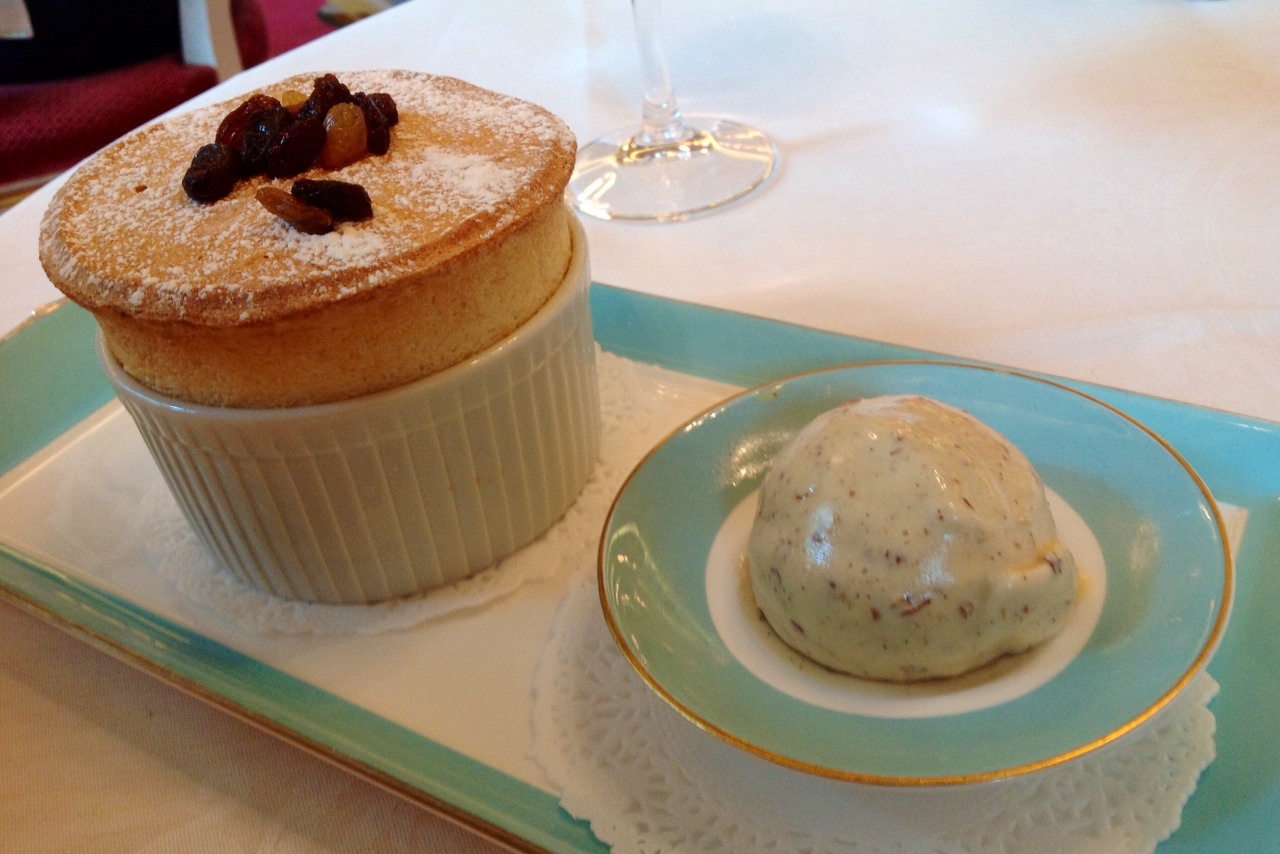
Vanilla soufflé and ice cream at the London Ritz


Mount Nelson tea buffet, Capetown

Olive-crusted lamb, The Lanesborough

Tempura di scampi at the Lanesborough


Scallops at l'Hotel, Paris


Chocolate cherry dessert, Le Meurice. Paris


Your input is welcomed:  hotel-musings@hotmail.fr

Next Friday:  "Remembering Diana Dors"

  [Photos are mine, unless otherwise credited]


CROSS REFERENCING … a look at other postings
Ann was also featured in blog No. 5 "Room without bath," 28 Sept., 2012; No. 20 "Decaffeinated Coffee in Hungarian?" 11 Jan. 2013, and No. 28 "Rue des Beaux-Arts."  The Sherry Neverland was the setting for part of blog No. 53 "Looking For Carlotta" 24 Jan. 2014  (to access, click on titles)


Monday, February 18, 2013

25 - The Importance of a Morning Suit


THE RITZ HOTEL, Paris


The Ritz' Espadon restaurant, summer terrace  (2010)

Years ago, long before I made my life with Brenda, I discovered the Ritz Hotel’s wonderful business luncheon.  The chef proposed everything that was the best of the day:  tasters, starter, main course, cheese, dessert, coffee and more sweets.  And all this for about 50 dollars (this is going back a few years). 

I became quite a regular client, often lunching solo.

Luigi, the host-maître d’hôtel, always seemed delighted to see me.  On this particular day some twenty years ago I vaguely sensed something changed.

Star chef Michel Roth in Ritz kitchen
 I was attuned to the fact that a new gentleman in morning suit was participating in the service.  I knew that each level of command in the French hotel hierarchy carried with it a precise category of clothing, and as I understood that the morning suit indicated top man, I was surprised to see that Luigi –surely the chief maitre d’hotel—was dressed in a simple, dark suit.

I was just making idle conversation and had no inkling of reopening a dramatic wound.  When I clumsily asked why he wasn’t wearing his morning suit, I thought he was going to burst into tears.

« You have noticed, of course, that I am no longer … », he seemed unable to finish, and injected a brave smile.  « Yes, the man you saw earlier is the chief, the new director. »

« But surely you are the head of the waiters, » I ventured, not knowing how to back up, having uncovered this indelicate can of worms.

Classic morning suit in 1898 watercolor
 « You see, during two years, there was no director, » he said, as though delighted in the complicity of a client who had finally noticed. «So I was like the acting head.  And now with the appointment of this man, I am no longer anything.  And to make sure that I understand perfectly what has happened to me, I have been instructed to return my morning suit. »

I sincerely commiserated and said how unjust this all seemed.

Towards the end of the meal, Luigi returned to say how much my comments had meant to him, how rare it was to hear when people were happy with the restaurant.  He said it was disheartening how many people wrote to say bad things.  Just that week someone had written about a lunch months earlier, criticizing the service as well as the food.    I asked how much weight this kind of condemnation held, and he said it could be enormous.

L'Espadon (watercolor by B.Redmond)
 When I said that my tendency was simply not to return to a hotel or restaurant when unhappy, but that I loved to write when the experience was outstanding, his eyes lit up.   He didn’t quite dare say anything immediately, but before I left, he managed to convey in the most discreet and delicate manner how much a complimentary letter sent to the right person could mean in his precarious situation.

I was more than happy to oblige.  Even though it didn’t get his morning suit back, my letter apparently did give a certain boost to Luigi’s professional self esteem and cemented an enduring complicity between us until his retirement several years ago.


L'Espadon Restaurant in 1955, unidentified gentleman in foreground  (Google photo)


SIDEBAR:  The last Night at the Ritz ... out with a bang!

Brenda and daughter Fiona in main lobby last July,  Ritz' last Sunday


It was a full house for the Ritz’ closing night. 

Boarding-up its ornate 18th century doors last July, the granddaddy of Parisian luxury hotels began a major overhaul expected to last at least another two years.

The hotel was booked solid that last Monday night, and at prices way out of the realm of most of us ordinary mortals (reportedly 14,000-dollars for the Coco Chanel suite, named after one of the hotel's most prestigious residents).


Portion of bedroom in Coco Chanel Suite (Associated Press photo)


Star chef Michel Roth proposed a special 300-dollar menu for his “au revoir dinner” (foie gras, lobster and caviar, pigeon and cherries, ending with a peach Melba, the most famous creation of the hotel’s first chef Auguste Escoffier).  Wine and coffee were not included, but the restaurant still sold out. 

Well-heeled regulars came from around the globe for the final days.  Rarely have so many flags been raised at the same time to announce guests’ nationalities:  clients from Hong Kong, Japan, U.S.A., Singapore, Russia --not to mention France and the rest of Europe-- filled the iconic old palace one last time.

Despite promises to uphold tradition, some conservative regulars feared an overly modern transformation.  “We wanted to spend one more night here before it was too late,” an elderly German gentlemen said.  “You never know what it’s going to be like in two years time.”

“It’s so sad.  We’ve been coming here for over 20 years,” said a teary-eyed Hong Kong matron.  “Some of the plumbing may need changing, but we love it.  It’s historical, and it’s home.”  As reported by the French press agency, she embraced all staff she encountered in the lobby before heading out onto the Place Vendome.

The 200-million dollar facelift, in addition to all of the obvious heating-airconditioning-electricity refittings, will equip the Ritz with a state-of-the-art spa and spectacular new garden restaurant with a retractable glass ceiling.

Putting on the Ritz (Google)
 At its opening in 1898, the Ritz was the first in the world to have electricity in every room and en-suite bathrooms in most.   

 It inspired Irving Berlin's 1929 song “Putting On The Ritz” and the novella “The Diamond As Big As The Ritz” by Scott Fitzgerald, once a reguzlar guest with his wife Zelda.

Owned since 1979 by Egyptian tycoon Mohamed Al Fayed, it was here that Princess Diana had her last meal with Al Fayed’s son Dodi in 1997.

All bedrooms will be completely redecorated, but a Ritz spokeswoman said they would stay traditional in style, in the hotel’s trademark tones of pink and blue.  A public letter from the hotel's managing director promised to ensure that the “charm and personality of the Ritz is kept alive.”

“The Ritz will remain the Ritz,” pledged a hotel spokesman recently in its newsletter.  “Its DNA will remain intact.”


Vintage Ritz dinner, probably the 1930's (photo Ritz Hotel archives)


Your input is welcomed:  hotel-musings@hotmail.fr

Next Friday:  "Babe Ruth's 60th Home Run, back to the Aberdeen Hotel"

[Photos are mine, unless otherwise credited]


CROSS REFERENCING … a look at other postings
The Ritz Hotel was also featured in sidebar for blog No. 18, "Cesar Ritz" Dec. 28, 2012  (to access, click on above title).